

Development
Property Development Feasibility 101: Running the Numbers Before You Commit
TL;DR: A feasibility works backwards from the finished value: subtract every cost to create the homes and the margin you need for the risk, and what is left is the most you can pay for the land. If a project is not feasible on paper, the market rarely rescues it.

Have you ever looked at a development site and wondered what it is genuinely worth to you, rather than what the agent is asking?
Do you know how much margin a project needs before the risk you are taking is worth carrying?
And what if the deal was already won or lost before you ever spoke to a builder?
It was. Ahead: how a feasibility works backwards from the finished value, a simple worked example you can follow line by line, the numbers that move it and how to protect them, and why all of this matters just as much if you are investing alongside a developer as it does if you are running the project yourself.
This post supports our FracHaus guide to property development.
A property development feasibility works backwards
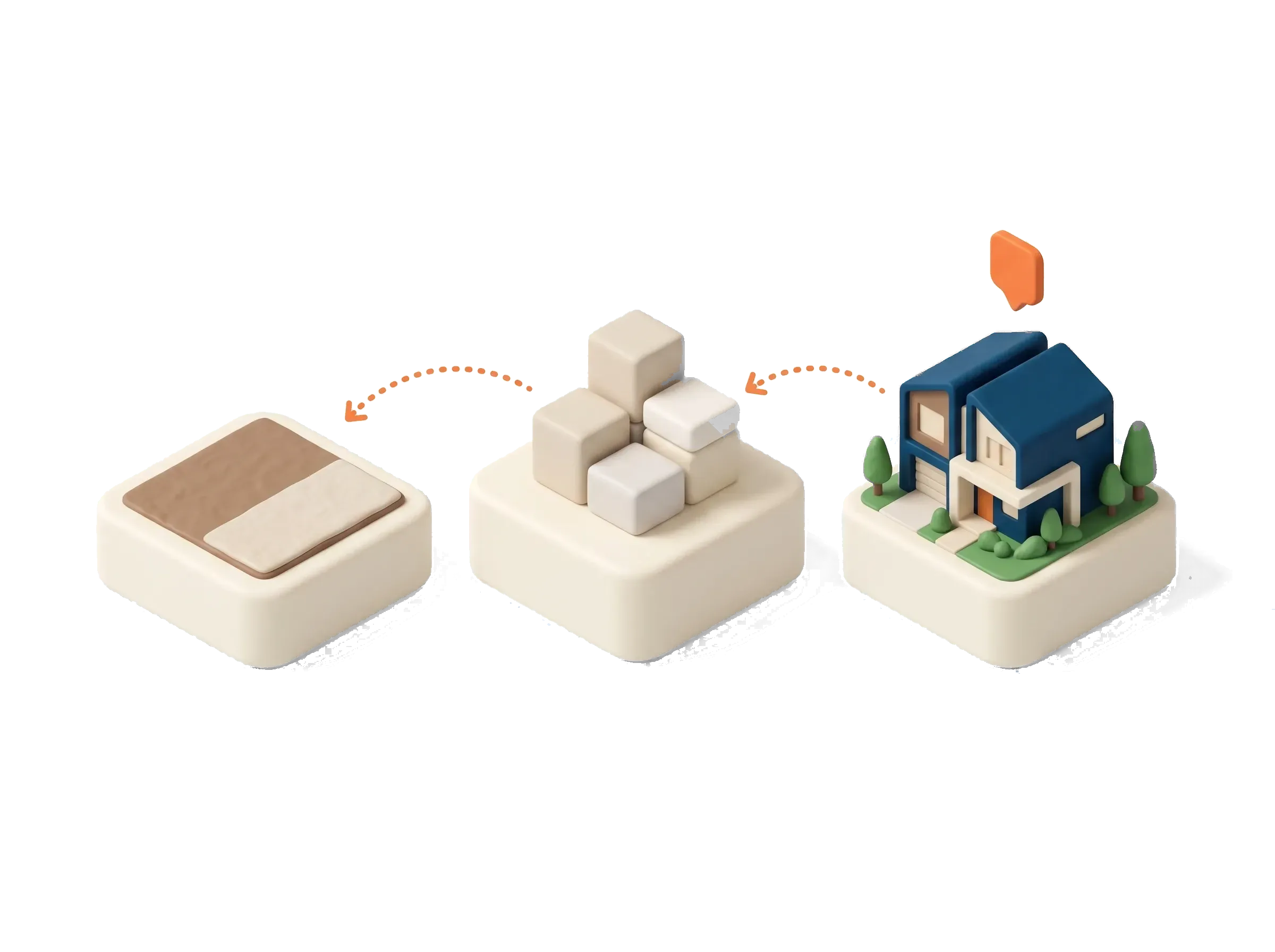
Most people think about development forwards: buy land, build, sell, hope for a profit. Developers think backwards. They start from the end value and work back to what they can afford to pay for the land.
The logic runs like this:
- Estimate the end value, what the finished homes are worth.
- Subtract every cost to create them.
- Subtract the margin you require for taking the risk.
- What is left is the most you can pay for the land. This is the residual land value.
If the asking price for the land is higher than your residual land value, the project does not work at your required margin. Simple, and brutal.
A simple worked example
Say two townhouses will be worth 650,000 dollars each when finished, so 1,300,000 dollars in total end value. (These numbers are illustrative only.)
- End value: 1,300,000
- Construction and design: 560,000
- Council, holding, finance and selling costs: 190,000
- Required margin (say 20% of end value): 260,000
Add the costs and margin: 560,000 + 190,000 + 260,000 = 1,010,000. Subtract from end value: 1,300,000 minus 1,010,000 = 290,000. That 290,000 is the most you can pay for the land and still hit your margin.
If the land is on the market for 250,000, you have room. If it is 350,000, the project does not work unless something changes: a higher end value, a lower build cost, or a smaller margin. And shrinking your margin to force a deal is how developers get hurt.
The numbers that move, and how to protect your development margin
Three inputs do most of the damage when they move:
- End value. Be conservative. Use realistic comparable sales, not the top of the market.
- Build cost. This is usually the biggest number and the most volatile. Fixed-price contracts and contingency help.
- Time. Every extra month is holding cost and finance cost. Delays quietly eat margin.
Good feasibility bakes in a buffer for all three. Our discipline is to stress-test the numbers, then only proceed when the margin still survives the stress. It is the same evidence-first approach we bring to deciding where and when to buy.
Why this matters to an investor
You might never run a feasibility yourself. But understanding it tells you what good looks like. When you co-develop for a cash return, the entire proposition rests on a feasibility that stacks up on day one. The growth is not hoped for, it is designed into these numbers before construction starts.
That is the difference between a genuine development and a gamble dressed up as one.
Next steps
- See how feasibility fits the wider project in the 7 stages of a small residential development.
- Return to the property development guide.
- Understand how the margin becomes your return in investing in property development for a cash return.
Frequently asked questions
What is the difference between a feasibility and a valuation?
A valuation tells you what a property is worth today, and is prepared by a licensed valuer. A feasibility is a forward-looking projection of whether creating something new will make money, built from end values, costs, time and a required margin. Lenders usually want both, because they answer different questions: what is the security worth now, and does the project stack up.
Why do developers work backwards from the end value?
Because the end value is the one number the developer cannot control. Costs can be negotiated and margins can be set, but the market decides what a finished home is worth. Starting from that fixed point and subtracting costs and margin tells you the maximum you can pay for the land, which converts a vague hope into a hard walk-away number.
What costs do people most often leave out of a feasibility?
Soft costs are where first-timers get caught: finance interest and line fees over the full build period, holding costs on the land, selling commissions and marketing, and professional fees for consultants. Contingency is the other common omission. On a project running eighteen months, the money and the selling can consume a large share of what looked like the margin.
How conservative should end values be in a feasibility?
Use realistic comparable sales rather than the best result the suburb has ever produced, and test the project against a lower figure to see whether the margin survives. Optimistic end values are the single easiest way to make a bad project look good on paper, because the error is invisible until settlement, when it is far too late to fix.
Does GST affect a development feasibility?
Yes, and it is significant. Sales of new residential premises generally attract GST, and the margin scheme may reduce the amount payable depending on how the land was acquired. Because the treatment changes the net revenue materially, GST needs to sit in the feasibility from the start rather than being discovered later. This is a matter for your accountant, not a spreadsheet assumption.
Can a feasibility change after you buy the site?
Frequently. Build costs move, approval conditions add requirements, timelines stretch and market conditions shift. A good developer re-runs the feasibility at every major decision point rather than treating the original as settled. The purpose of building in a buffer is precisely so the project can absorb those changes without the margin disappearing.